Vol. 4 No. 1 (2026): Performance, Power and Public Life
Editorial Introduction
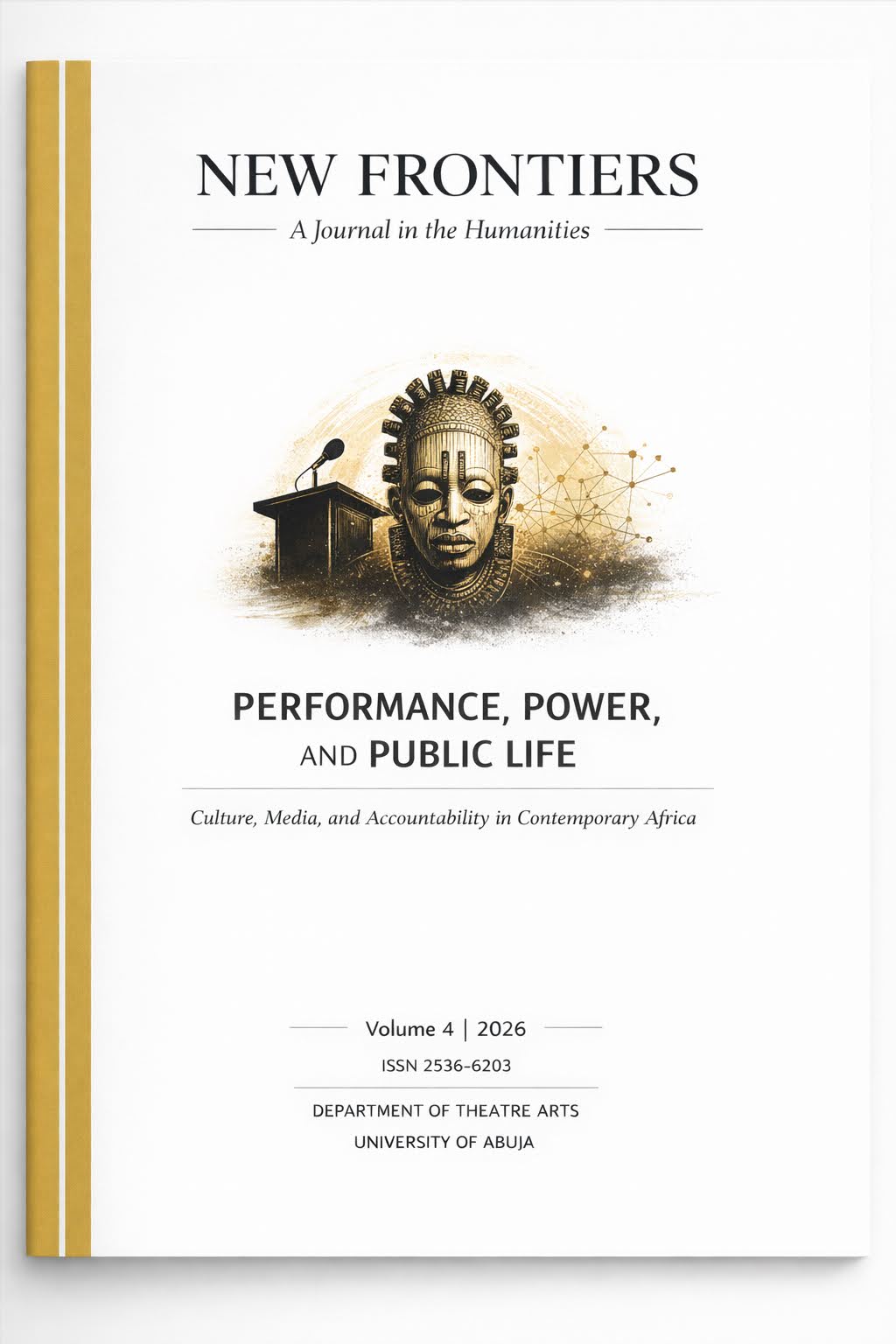
Performance, Power, and Public LifeThe fourth volume of New Frontiers: A Journal in the Humanities gathers its contributions under the theme “Performance, Power, and Public Life.” The theme is not decorative. It signals a shared concern that threads—sometimes quietly, sometimes insistently—through the essays collected here: the recognition that contemporary African realities are not simply experienced; they are staged, narrated, embodied, regulated, and, at times, resisted in highly visible ways. Legislative chambers, digital platforms, ritual spaces, historical drama, cinematic production, language revival initiatives, and professional institutions all become sites where power is enacted rather than merely exercised. Public life, in this sense, appears less as a neutral arena and more as a theatre of negotiation—one in which authority is asserted, contested, reframed, and occasionally unsettled.
Several of the essays challenge the lingering assumption that performance belongs primarily to the proscenium stage. That assumption, while understandable, is no longer tenable. Performance extends into media narratives, governance practices, social movements, costume traditions, language politics, and even regulatory frameworks. It is perhaps more accurate to describe performance here as the visible and symbolic enactment of legitimacy, resistance, identity, and memory. From this angle, the humanities do not simply interpret culture; they offer analytic tools for examining how societies script themselves and how citizens read, reinterpret, or disrupt those scripts.
A number of contributions interrogate the performative dimensions of political authority and media representation. Analyses of newspaper framing during moments of legislative controversy suggest that journalistic discourse does not merely report institutional conflict—it structures the terms under which legitimacy is recognised or withheld. Editorial choices, rhetorical emphases, and narrative sequencing become stabilising or destabilising gestures within democratic systems. This does not imply that the press operates with uniform intention. Rather, it indicates that reportage participates in the dramaturgy of governance. Similarly, studies of negative propaganda reveal how political actors mobilise cultural symbols, coded language, and repetition to consolidate power and shape civic perception. Governance, from this vantage point, appears at least partly dramaturgical: it depends on staging, framing, choreography, and strategic reiteration.
Digital platforms introduce another layer of complexity. The examination of X (formerly Twitter) in relation to the #EndSARS protest illustrates how networked communication can transform dispersed grievances into visible collective action. Hashtags function almost like scripts; retweets operate as cues; livestreams create improvised stages. Yet this transformation is not unambiguously emancipatory. Digital activism amplifies voice, but it also exposes movements to misinformation, performative outrage, and rapid polarisation. From another angle, the study of the Masoyinbo online programme demonstrates that social media may serve not only as a tool of mobilisation but also as an instrument of cultural preservation. In that context, the use of indigenous language becomes a performative claim to identity within a digital order still shaped by colonial linguistic hierarchies. The digital sphere, then, is neither purely disruptive nor purely preservative—it is a contested stage.
Historical memory forms another critical axis of inquiry. Essays on traditional theatre forms in Okunland and on the dramaturgical reinterpretation of Benin history underscore how performance sustains communal memory while simultaneously reworking it. When playwrights revisit figures such as Obaseki and Oba Ovonramwen Nogbaisi, they do more than recount past events. They reinterpret leadership, betrayal, resilience, and dignity through contemporary sensibilities. History, in these readings, resists being reduced to archive or record. It becomes a living resource, reactivated through dramaturgy to address present anxieties and ethical tensions. The past, one might say, is staged not to be preserved unchanged but to be argued with.
Questions of embodiment and representation complicate the analysis further. The re-theorisation of female identity in historical cinema suggests that sexual objectification functions not merely as interpersonal diminution but as a subtle mechanism of governance. Cinematic framing, narrative progression, and aesthetic emphasis can render the female body symbolic infrastructure for patriarchal authority—until moments of resistance expose the instability of that arrangement. In a distinct yet related register, the study of Benin chieftaincy costume reveals how regalia operates as a semiotic system. Hierarchy, lineage, wealth, and ritual authority are encoded and communicated through fabric, ornamentation, and regulated display. Dress does not simply adorn authority; it constitutes it in visible form.
The volume concludes its arc with reflections on professional ethics and regulation. The inquiry into ethical accountability in Nigerian public relations practice suggests that institutional legitimacy is itself performative. Where regulatory frameworks are inconsistently enforced and sanctions unevenly applied, professionalism risks becoming projection rather than practice. This observation does not dismiss the efforts of practitioners; rather, it reframes credibility as structurally conditioned. Professional integrity, in this context, depends as much on institutional choreography as on individual virtue.
Taken together, the essays suggest that public life operates through layers of symbolic action with material consequence. Media headlines can stabilise or inflame institutional trust. Digital posts can mobilise collective energy or distort it. Ritual performances preserve memory even as they reshape it. Costumes encode authority; films interrogate governance; regulatory practices either sustain or erode professional credibility. Across these domains, performance emerges less as metaphor and more as mechanism.
In an era saturated with spectacle and accelerated by digital transformation, the humanities retain a distinctive relevance. They make visible the scripts of authority, the choreography of resistance, and the symbolic economies that structure everyday life. By analysing how power is staged and how identity is negotiated within public arenas, the contributors to this volume reaffirm the intellectual vitality of theatre studies, media analysis, cultural theory, feminist critique, and communication scholarship within contemporary African contexts.
“Performance, Power, and Public Life” therefore functions not simply as a theme but as an invitation. It encourages readers to attend carefully to the dramaturgies embedded in governance, the semiotics of digital culture, the embodied languages of tradition, and the ethical performances of professional institutions. In doing so, this volume extends the mission of New Frontiers: to foster interdisciplinary scholarship that is rigorous yet reflective, culturally grounded yet critically self-aware, and attentive to the shifting contours of African public life.
If the essays that follow demonstrate anything, it is this: to study performance is, in many cases, to examine how power becomes visible. And to examine power, however cautiously, is to confront the structures that continue to shape public life.
Professor Olympus Ejue, Editor